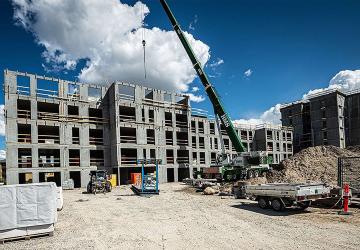
Steel construction is by definition project-based. No mass production, but unique structures with specific requirements, fluctuating material prices, and tight schedules. Calculation, engineering, work preparation, production, and assembly are inseparably connected. A small change in the design phase can have major consequences for procurement, processing times, or assembly planning. This interdependency is exactly where the complexity of steel construction lies. And that is also where the difference between control and fragmentation arises.
Project-based dynamics require central control
In many steel construction companies, processes have grown historically. Calculations are built in spreadsheets, work preparation uses separate files, production records hours in a standalone system, and project monitoring happens afterward. The information exists, but is not always connected. This makes it difficult to answer essential questions during the project:
- What is the current cost price of this project?
- How do actual hours compare to the estimate?
- What impact does a change have on materials and planning?
- Where do deviations in margin occur?

Time tracking also plays a crucial role
What does integrated mean in practice?
An integrated ERP system in steel construction means that all core processes operate within one environment and use the same data. Information is recorded once and then reused in subsequent process steps. The calculation forms the starting point. Material types, operations, hourly rates, and markups are structured systematically. Once a project becomes an order, this calculation directly forms the basis for work preparation, procurement, and planning. There is no transfer via separate files or manual re-entry. When changes occur during execution—which is more the rule than the exception in steel construction—they remain traceable within the same system. Additional and reduced work is linked to the project and directly affects the current cost overview. This creates a central data flow from quotation to post-calculation. The system is not a collection of separate modules that must be purchased individually, but one cohesive environment in which all core processes are connected by default.

With MatrixMetaal you can quickly create professional quotations
From calculation to realization without information loss
In steel construction, the calculation has a direct impact on production. The chosen profiles, plate thicknesses, connections, and operations determine not only the cost price, but also the workload of the workshop. When calculation and work preparation operate within the same ERP system, this relationship becomes transparent. Work preparation builds on the assumptions from the calculation. Material requirements can automatically be translated into purchase proposals. Operations align with available capacity. This prevents discrepancies between what was estimated and what is actually produced. Time tracking also plays a crucial role here. By feeding actual hours per project and operation back into the system, insights into deviations emerge. Are certain operations consistently more time-consuming than estimated? Then the calculation methodology can be adjusted accordingly. In this way, post-calculation becomes not just an administrative closure, but a management tool.

From calculation to realization
Control over margin during the project
In steel construction, margins are not only determined when issuing the quotation, but throughout the entire project. Material prices fluctuate. Deliveries may be delayed. Design changes require adjustments. Without up-to-date insight into costs and progress, it is difficult to make timely adjustments. An integrated ERP system provides project monitoring based on current data. Budgeted costs, actual costs, and remaining commitments are compared side by side. This creates a realistic picture of the expected final margin—not afterward, but during the project. Thanks to extensive analysis capabilities, deviations can not only be identified, but also explained in detail. This makes adjustments concrete and well-founded. For project managers and management, this means:
- insight into progress and costs per project
- substantiation of decisions regarding changes
- better control of additional and reduced work
- timely identification of deviations
Less transfer, more transparency
An important advantage of one central project environment is that departments are no longer dependent on separate transfers. Calculation, work preparation, procurement, and production work with the same source of information. This results in:
- less duplicate input
- fewer interpretation differences
- better internal communication
- higher reliability of project data
From insight to predictability
The real added value of integration lies in the predictability it provides. By structurally gaining insight into deviations between estimation and realization, a learning organization emerges. Calculations become more realistic. Hourly rates are better substantiated. Processing standards are sharpened. Project risks are better assessed. This directly translates into more reliable quotations and more stable margins. In a market where competition is high and price pressure remains, that predictability makes the difference. The implementation of an integrated ERP system is therefore not purely a technical step, but an organizational choice. It requires standardized working methods, clear documentation of assumptions, and discipline in data usage. Successful implementation also requires guidance from specialists who understand the steel construction practice and can translate processes into a workable system setup.
Conclusion
Control over steel construction projects does not come from working harder, but from logically connecting information. When calculation, work preparation, production, and project monitoring operate together within one integrated ERP system, clarity replaces fragmentation. Project information remains consistent, deviations become visible, and decisions can be made based on current data. For steel construction companies, this means more control over projects, better substantiation of quotations, and above all: more certainty about the final margin. This is not an IT issue, but a strategic choice for structural control of the project process.